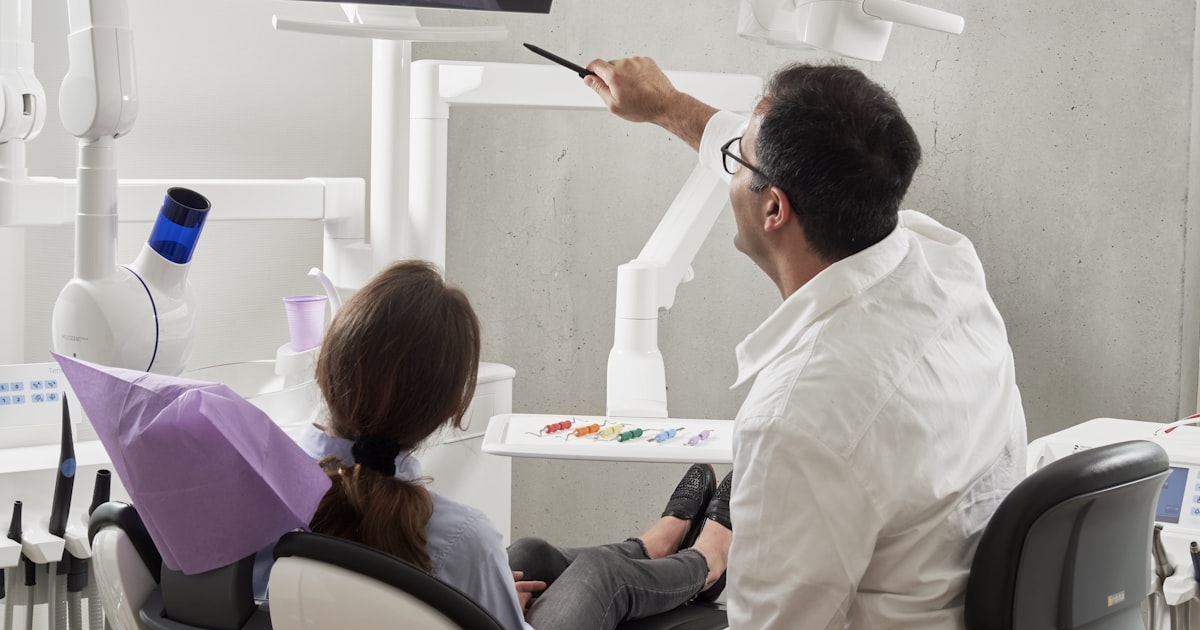
There's a conversation that happens in dental practices across the country so often it practically runs on autopilot. Patient wants whiter teeth. You assess, you check the history, and then you spot the sensitivity. Maybe it's generalised, maybe it's localised, maybe it's something they've been quietly managing for years. And now you're in that familiar position where you want to help, you can see they're keen, and the honest professional answer is: we probably need to deal with the sensitivity first, and then we'll see where we are with whitening.
Which is fine. That's responsible, evidence-based care. But let's be honest with ourselves for a second: how many of those patients actually come back for the whitening stage? How many get halfway through a desensitising protocol, feel a bit better, and then life gets in the way? We've all watched it happen. The enthusiasm fades, the follow-up appointment gets rescheduled once, twice, and then quietly disappears from the diary altogether.
The Sensitivity-Whitening Problem Nobody Really Solved
This has been one of those accepted frustrations in cosmetic dentistry for a long time now. Sensitivity and whitening have always existed in opposition. The very mechanism that delivers bleaching results (peroxide penetrating enamel and oxidising chromogens in the dentine) is precisely what triggers a sensitivity response in vulnerable teeth. So the clinical pathway has always been sequential: stabilise the sensitivity, wait, then attempt whitening cautiously.
And for patients who already present with sensitivity? Many of them simply get told that whitening isn't suitable for them. Full stop. Which, if you think about it from the patient's perspective, is genuinely disappointing. They came to you excited about improving their smile, and they left being told their teeth won't cooperate. We've all seen that look.
The products available haven't really helped bridge this gap, either. You've got your desensitising agents on one shelf and your whitening systems on another, and never the twain shall meet. Potassium nitrate toothpastes for the sensitivity. Carbamide peroxide or hydrogen peroxide gels for the whitening. Two separate protocols, two separate timelines, two separate conversations with the patient. It works, technically, but it's clunky and the dropout rate tells its own story.
What If You Didn't Have to Choose?
This is the question that Dr Wyman Chan asked, and the answer he developed is genuinely the first of its kind. DWC8 is the world's first combined teeth desensitiser and whitener: a single formula that simultaneously addresses sensitivity while delivering professional whitening results. Not one after the other. At the same time.
Take a moment with that, because it really does change the clinical picture. A patient walks in with sensitive teeth and a desire for whitening. Instead of the two-stage conversation, instead of managing expectations downward, you can now offer a single protocol that tackles both concerns in one treatment window. The patient uses trays or retainers overnight (minimum two hours), and within ten days, you're looking at measurable results on both fronts: reduced sensitivity and visibly whiter teeth, up to eight shades lighter.
For the patients who were previously told whitening simply wasn't an option for them, this is transformative. And honestly, for the clinician, there's something deeply satisfying about having a single elegant answer to what used to be a two-part problem.
The Mechanism: Why Dual-Action Actually Works
You might be wondering how a single formulation can desensitise and whiten simultaneously without the whitening component aggravating the sensitivity. It's a fair question, and the answer lies in DWC8's alkaline conditioning approach.
The formulation promotes remineralisation of damaged enamel, actively encouraging calcium and phosphate uptake into the tooth structure. This is the desensitising pathway: as the enamel repairs and strengthens, the dentinal tubules that were transmitting those sharp sensitivity signals become occluded. The tooth literally becomes more resilient. Meanwhile, the whitening component works through the same treatment period, oxidising intrinsic stains while the remineralisation process is running alongside it.
What makes this work rather than fight against itself is the alkaline environment. Where traditional whitening systems tend toward acidity (which can exacerbate sensitivity and demineralisation), DWC8's alkaline formulation creates conditions that actively support enamel health while the whitening takes place. The two processes aren't competing for the same biochemical territory; they're operating in complementary pathways within the same treatment window.
The sensitivity reduction typically becomes noticeable within five to seven days. Whitening results are visible within ten. And because the enamel is being strengthened throughout, you're not trading one problem for another. The teeth are genuinely in better condition at the end of the protocol than they were at the beginning.
The Orthodontic Application You Might Not Expect
Here's something that gets overlooked in the initial excitement about the sensitivity-whitening combination, and it's actually one of the most clinically interesting applications of DWC8.
You know those white patch demineralisation lesions that show up after fixed orthodontic appliances come off? Those chalky, opaque spots where the enamel has been compromised around bracket sites? They're incredibly common, they're cosmetically distressing for patients (especially young patients who've just spent two years looking forward to their brackets coming off), and the treatment options have historically been limited to either watching and waiting for remineralisation, or moving toward more invasive interventions like resin infiltration or microabrasion.
DWC8's remineralisation pathway offers a non-invasive approach to healing these white patch lesions. The alkaline conditioning promotes mineral uptake directly into the compromised enamel, and the fact that it's being delivered via trays means you get sustained contact time with those affected areas. For post-orthodontic patients, this means you can address the white patches while simultaneously offering them the whiter smile they were hoping for once the brackets came off. That's a genuinely lovely thing to be able to offer someone who's been through a long orthodontic journey.
What This Means for Your Practice Conversations
Let's talk about the practical reality of having something like this in your toolkit, because the clinical mechanism is only half the story. The other half is what it does to your patient conversations.
Think about sensitivity whitening cases you've seen in the last month. How many patients raised whitening as something they were interested in? And of those, how many had some degree of sensitivity that complicated the picture? If your experience is anything like most practices, it's a significant proportion. Sensitivity is one of the most commonly reported dental complaints in the UK, and whitening is consistently one of the most requested cosmetic treatments. The Venn diagram overlap is enormous.
With DWC8, that overlap stops being a problem and starts being an opportunity. Instead of a conversation that involves tempering expectations and explaining why things need to happen in stages, you get to have a conversation that's genuinely exciting. "Actually, we can address both of those things together." Watch a patient's face when you say that. It's one of those moments that reminds you why you got into this profession.
There's a compliance advantage too, and it's worth noting because compliance is where so many treatment plans quietly fall apart. When the patient can see whitening results happening alongside the sensitivity improvement, they stay motivated. They keep using the trays. They come back for the review appointment. The two outcomes reinforce each other: the visible whitening progress encourages continued use, and the continued use drives further desensitisation. It's a virtuous cycle, and it's built right into the treatment design.
Fitting DWC8 Into Your Existing Workflow
The protocol itself is straightforward. Custom trays or the patient's existing retainers, DWC8 gel applied, worn overnight or for a minimum of two hours. No chairside time beyond the initial consultation and tray fabrication (if needed). No complex multi-product sequencing. For practices that already offer whitening, this slots into your existing workflow with very little disruption. For practices that have been cautious about offering whitening to sensitivity patients, it opens up a whole new category of treatable cases.
And if you're already using other products from the range, DWC8 integrates naturally. Once sensitivity has improved (typically within a week), patients can transition to HP6% Perfect Trays or HP6% Get2Smile for ongoing whitening maintenance. The DWC8 protocol essentially creates the foundation that makes further whitening safe and comfortable.
A Genuinely New Category
It's worth stepping back and appreciating what "world's first" actually means here, because that phrase gets thrown around a lot in dental marketing and most of us have learned to raise an eyebrow at it. In this case, though, it's accurate in the most literal sense. Before DWC8, there was no product anywhere that combined desensitising and whitening into a single simultaneous treatment. They were separate categories, separate products, separate appointments. Dr Wyman Chan didn't just improve an existing approach; he created an entirely new one.
For dental professionals who pride themselves on offering the best and most current care to their patients, that matters. And for the patients sitting in your chair who've been told their sensitive teeth mean whitening isn't for them, it matters even more. Sometimes the most meaningful innovations aren't the flashiest ones. Sometimes they're the ones that quietly solve a problem everyone had simply accepted as unsolvable.
This is one of those.